

Welcome!
A4 PULLEY INJURY REHABILITATION PROGRAMThe first step to recovery is acknowledging your injury, so you’re well on your way! Here, we’ll walk you through what you need to do to take care of your pulley and get back to the crag strong, healthy, and pain-free.
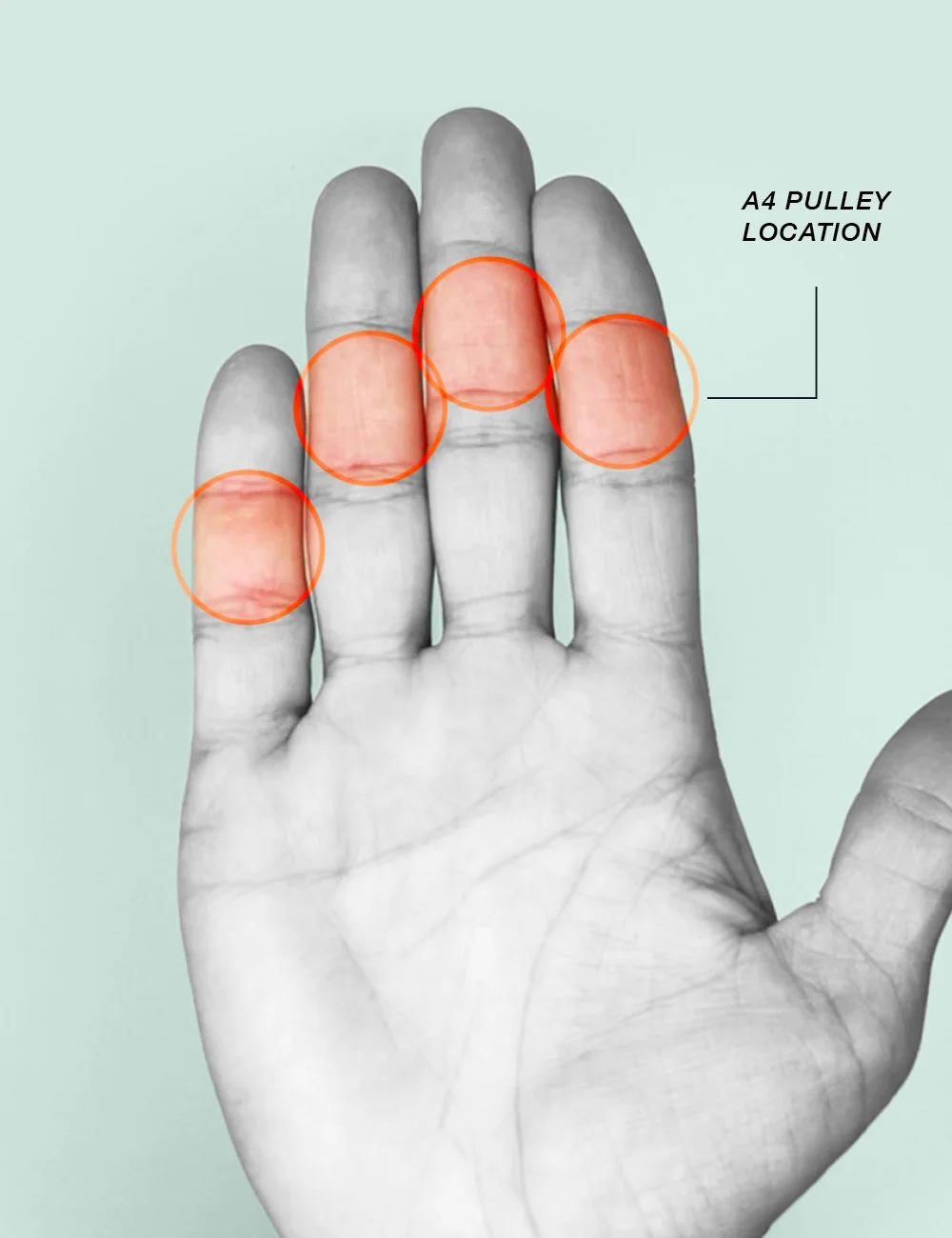
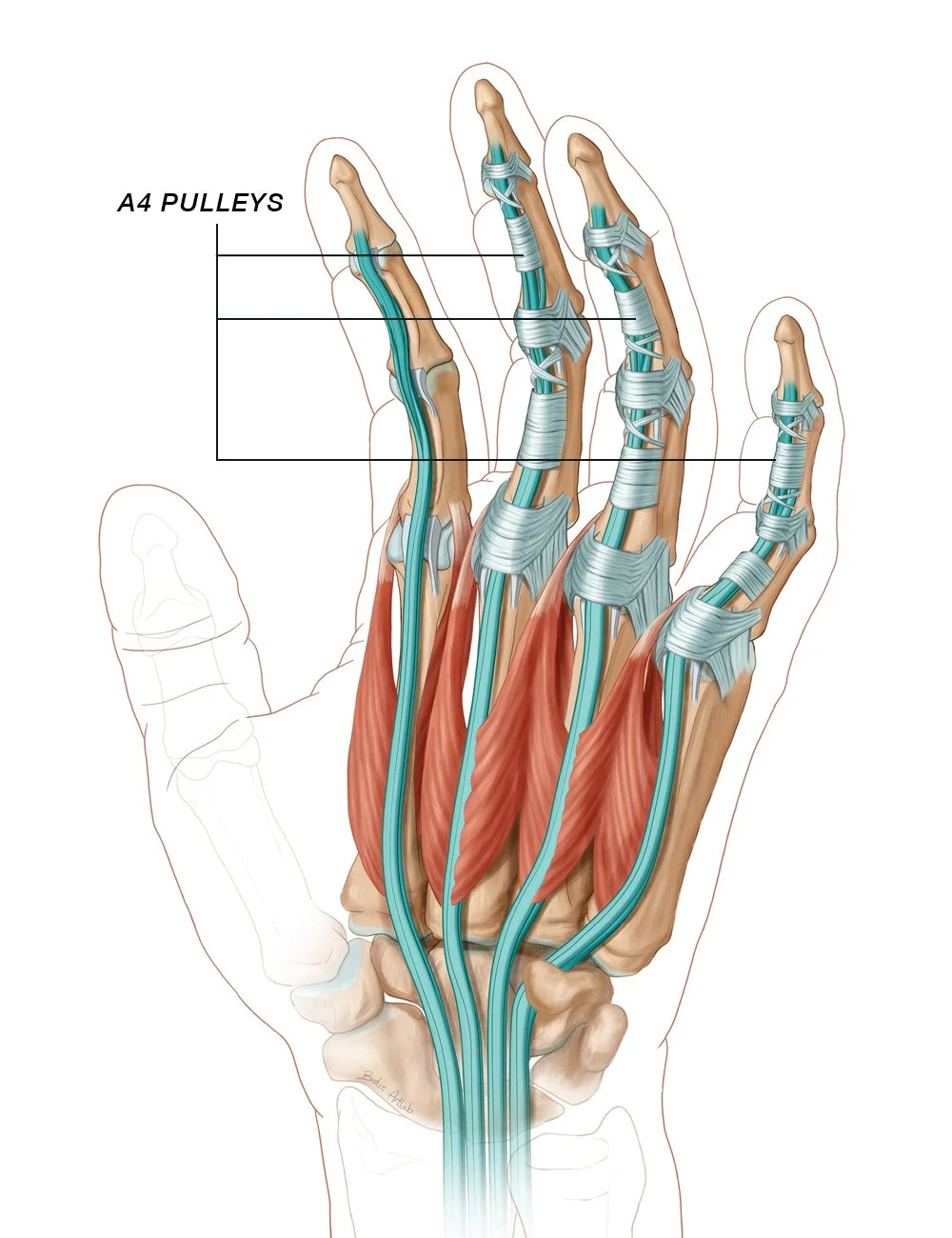
PULLEY INJURIES: THE BASICS-
If you don’t feel like you have a solid grasp on what a pulley is or how it works, take a quick look at these finger anatomy basics so that you can better get a feel for what’s going on in there.
-
A pulley injury occurs when the load on the finger exceeds the pulley’s ability to resist that load. When this happens, the pulley will stretch, tear, or rupture, causing the pulley to partially (or completely, in the case of rupture) pull away from the bone. A tell-tale sign of a pulley rupture is an audible “pop” at the time of injury. But not every pulley injury is a full rupture.
-
• Tenderness to the touch along the injured pulley
• Swelling or inflammation, bruising or redness, or just a feeling of stiffness in the finger that is mostly present in the area of the pulley
• Pain with active grip, especially any grip the involves bending with the tip of your finger. This can be closed grip or open grip though full crimp is typically the most painful.
Ready to get started?
If you already know your rehab category, choose the severity of your pulley diagnosis below to be taken to the correct section of the program. If you don’t know how severe your pulley injury is, we recommend getting a professional diagnosis.
(And before getting started, please make sure to read this disclaimer.)
FULL A4 PULLEY REHAB PROGRAM OVERVIEW-
The goal of this phase is to allow the pulley to reattach or form a union back onto the bone before we start loading it.
Only required for severe pulley injuries.
Duration: 1-3 weeks
-
At this stage, the pulley may be re-attached, but those attachments are still healing and might not be strong enough to resist a deforming load. In this phase, we start to load the pulleys thoughtfully in order to bolster the healing time and the strength of a given pulley.
Required for severe and moderate pulley injuries.
Duration: 1-3 weeks
-
The goal of this phase is to load the finger. This is the most fun phase, but also the most tricky, because the pulley may be healed but the finger still isn’t strong. It’s the DANGER ZONE. Many people re-injure themselves in this phase.
Required for any pulley injury.
Duration: 2-3 weeks
-
Yay! You’ve arrived. Healed pulley, you’ve built your base and you are ready to (gradually) return to climbing normally! The goal of this phase is to reintroduce climbing movements that challenge the finger and your mind. This phase is the return to intuitive movement and performance.
-
Once you’re all healed, these are the things you can continue to do on a regular basis to avoid re-injury and make sure your pulleys stay strong and healthy.